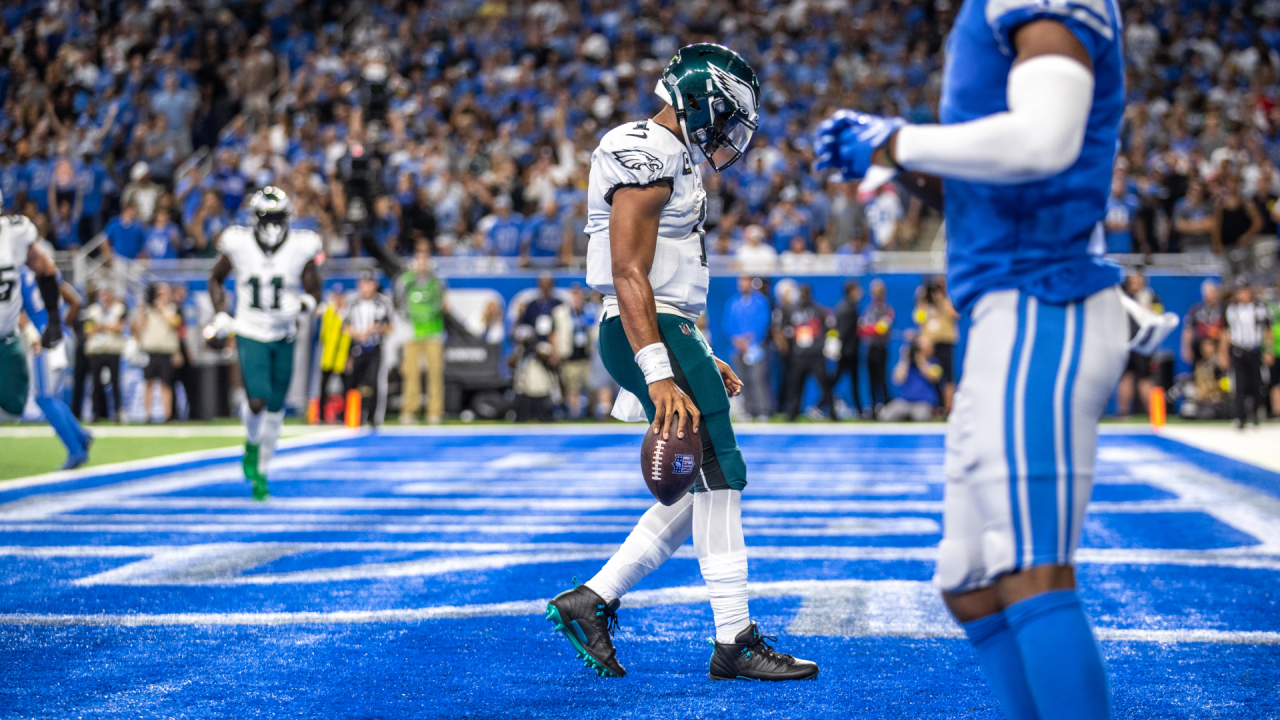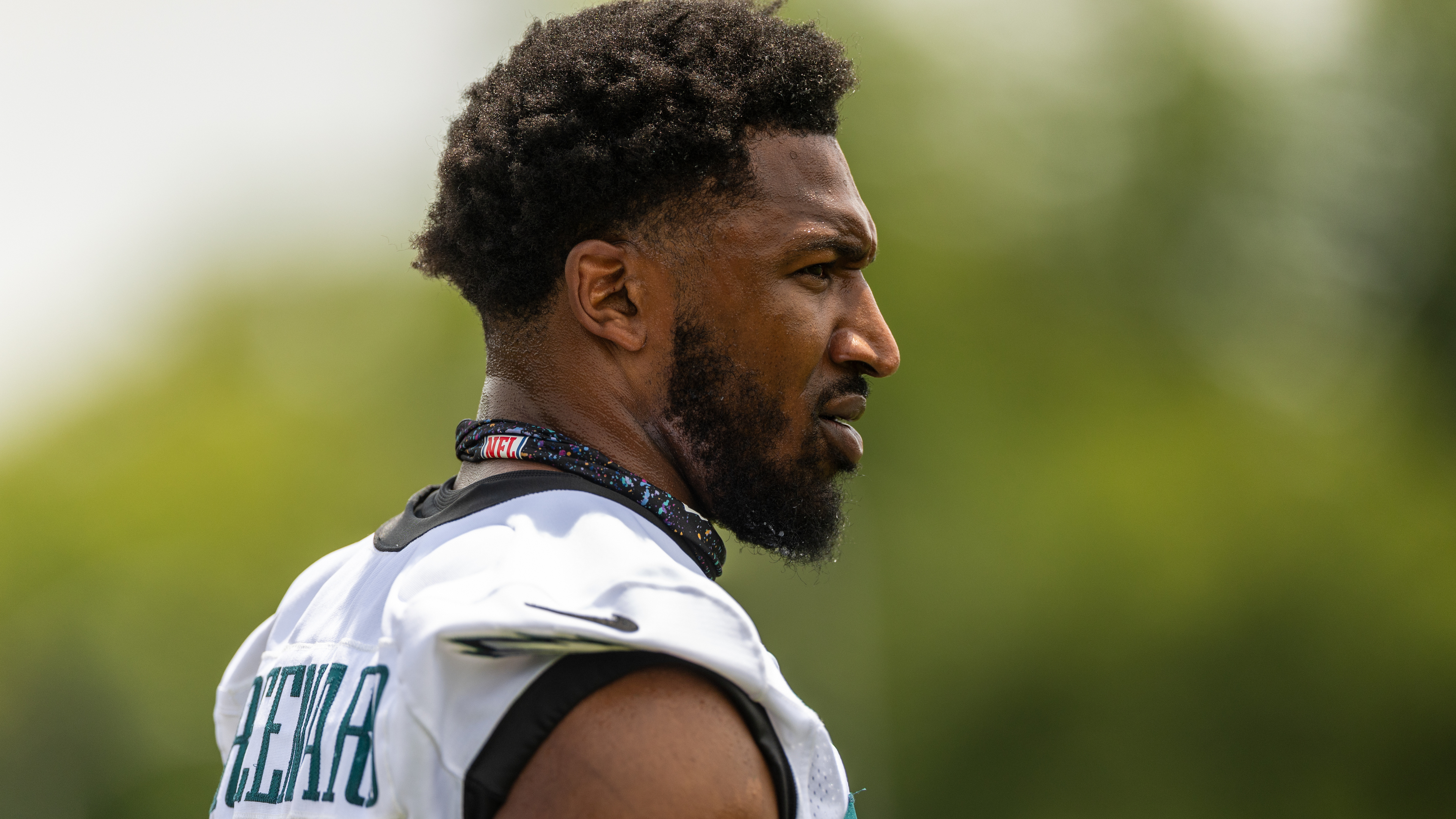
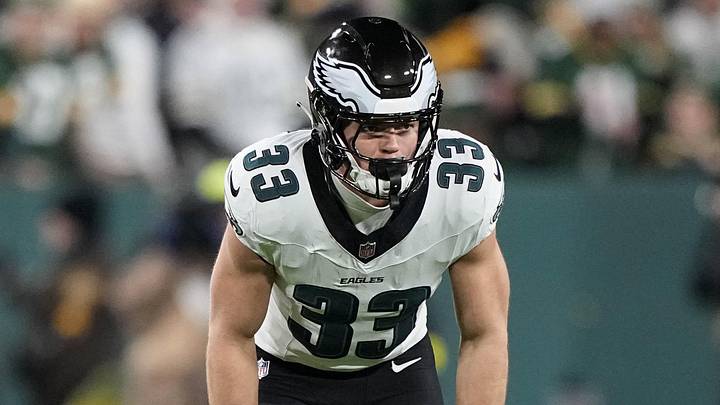
The Philadelphia Eagles already had the best cornerback tandem in the NFL. Quinyon Mitchell and Cooper DeJean became the first rookie-classmate duo to earn first-team All-Pro honors in the same season since the 1960s, then both raised their PFF coverage grades into the top eight of the league as second-year starters. That production alone, on rookie contracts, would have been the best young CB story in football.
Then Howie Roseman signed Riq Woolen.
The 6-foot-4 free-agent cornerback from Seattle joined the Eagles in March on a one-year, $12 million deal. He immediately became the highest-paid corner in the room. He also became the most unusual physical profile on the roster: a 6-foot-4 outside corner whose 4.26 forty time was the fastest ever recorded at the position at the NFL Combine. Vic Fangio had been chasing his Combine tape for years.
What was already an All-Pro tandem is now something the Eagles have never had: a three-deep cornerback room that gives the defensive coordinator complete scheme flexibility. Here is the deep dive on what each player brings, why the combination is historic, and where the room could break.
Quinyon Mitchell: The Lockdown #1
Mitchell's 2025 season was statistically one of the most efficient cornerback seasons of the decade. His 42.4 percent catch rate allowed was the lowest in a single season by any NFL cornerback since 2021, per Next Gen Stats (minimum 60 targets). Translation: when quarterbacks threw at Mitchell, they completed less than half the throws. That number is closer to what an elite WR1 averages on contested catches than what a typical NFL corner allows.
The path that got him there:
- 2024 (rookie): 46 tackles, 12 pass deflections, 1 INT in the regular season. 2 INT and 4 PD in 4 playoff games. Earned a 78.5 PFF overall grade, ranking 8th among all NFL cornerbacks. Drafted #22 overall out of Toledo, became a Week 1 starter immediately.
- 2025: First-team AP All-Pro. The catch rate number. Pro Bowl. 78+ PFF coverage grade for a second straight year. Operates as the boundary corner on Vic Fangio's right side of the formation.
Mitchell's game is press technique and route anticipation. He plays at the line of scrimmage, jams receivers off their releases, then runs with them on vertical routes. That style fits Fangio's scheme perfectly because the entire Fangio defense is built around the cornerbacks holding up in man coverage long enough for the safeties to rotate and disguise. Mitchell holds up. The numbers prove it.
Cooper DeJean: The Best Slot Corner in Football
DeJean is the player who turns the unit from "strong" to "historic." The Pick-Six off Patrick Mahomes in Super Bowl LIX is the play that put him in the national consciousness. The 2025 season is the one that made him an All-Pro.
- 2024 (rookie): 51 tackles, 6 PD, 1 forced fumble, 3 fumble recoveries in the regular season. 18 tackles, 4 PD, 1 fumble recovery, and the Super Bowl pick-six. 79.0 PFF coverage grade (tied for 6th in the league with Mitchell).
- 2025: First-team AP All-Pro. 2 INT, 13 PBU. 78.2 PFF overall (7th in NFL), 80.1 PFF coverage (4th in NFL). Led ALL slot cornerbacks in coverage grade (79.3), passer rating allowed (55.4), catch rate allowed (61.4%), and yards allowed per coverage snap (0.72).
DeJean is the most consequential slot corner in the league. The slot is where modern NFL offenses live: it is where their best route runners (the Cooper Kupps, the Keenan Allens, the Puka Nacuas) operate, it is where 70-plus percent of high-leverage third-down throws are targeted, and it is where most defenses get exploited. DeJean is currently the best in the league at not getting exploited there. At 22 years old. On a rookie contract.
Why Riq Woolen Changes Everything
If Mitchell and DeJean alone are the best tandem in the NFL, what does Woolen add? The answer is three specific things this defense did not have without him.
1. Height matchups. Mitchell is 6-foot. DeJean is 6-foot-1. The Eagles' starting boundary tandem could be physically outsized by 6-foot-3-plus receivers (the DK Metcalfs, the Mike Evanses, the Drake Londons of the league). Woolen at 6-foot-4 is a true tall corner who can match those receivers without help. He gives Fangio a personnel option to match the biggest WRs in the league one-on-one, which frees up the safety help to rotate elsewhere.
2. The deep ball. Woolen ran a 4.26 forty at the 2022 Combine at 6-foot-4, 210 pounds. That recovery speed translates: receivers do not run away from him deep. His career numbers prove it (12 career interceptions in 4 seasons, including a league-leading 6 picks as a rookie in 2022 with Seattle, plus another 3 INTs in 2024). The deep ball is the play type that has historically given the Mitchell/DeJean tandem the most trouble (both prefer to play tight at the line). Woolen erases that.
3. Scheme flexibility. With three legitimate starting-caliber cornerbacks, Fangio can run dime packages with three corners on the field full-time without dropping a safety to nickel. He can run press-man on one side and zone on the other. He can sub Mitchell or Woolen out for situational matchups. The defense's ability to disguise coverage doubles when three of its cornerbacks can credibly play three different roles.
Where Woolen Fits in the Scheme
The most likely formation usage in 2026:
- Base / nickel (about 70 percent of snaps): Mitchell at boundary corner (right side), Woolen at boundary corner (left side), DeJean in the slot. This is the new starting unit. Both starting boundary corners can press, both can recover deep, and the slot is locked down.
- Dime packages (about 15-20 percent of snaps): All three corners on the field plus an extra DB. The Eagles can play five legitimate coverage defenders simultaneously without removing a defensive lineman.
- Single-high / two-high disguise: Fangio's specialty. Having three corners who can all play press AND off-coverage gives the safeties more freedom to rotate post-snap. Woolen's deep range specifically lets the safeties cheat down toward the line of scrimmage more aggressively, knowing the deep third is covered.
Woolen himself said the quiet part out loud at June 9 minicamp: "I feel like we can be one of the best secondary groups in the league." The numbers back the talk. Mitchell, DeJean, Woolen, plus Reed Blankenship moving on to Houston means a new safety competition (Marcus Epps vs. Michael Carter II) where the loser still gets meaningful snaps.
The Comparable Units Around the NFL
What does this CB room look like in context? The other strong young CB groups around the league:
- Indianapolis Colts (Sauce Gardner + Charvarius Ward): Gardner is the consensus best pure cover corner in football. Ward is a steady veteran. They lack the slot corner equivalent of DeJean.
- New York Jets (Sauce Gardner + Reed): Same Sauce issue. Reed is a developmental piece, not a proven starter.
- Dallas Cowboys (Trevon Diggs + DaRon Bland): Diggs at his best is elite. Health questions. Bland's interception production has been historic but coverage grades are mixed.
- Denver Broncos (Pat Surtain II + Riley Moss): Surtain is a top-three CB. Moss has been an emerging starter. Lacks slot depth.
- Philadelphia Eagles (Mitchell + DeJean + Woolen): The only group with three top-25 PFF-graded cornerbacks. The only group with a true tall corner option (Woolen). The only group with a top-five slot corner (DeJean).
By depth, by physical diversity, and by combined PFF grade, the Eagles room is the best in the NFL heading into 2026. That is not a homer take. That is what the production says.
The Contract Math
The cost structure makes it more remarkable.
- Quinyon Mitchell: Year 3 of rookie deal in 2026. Carries a cap hit of approximately $4.5M. Will be due an extension after 2026 that will reset the cornerback market.
- Cooper DeJean: Year 3 of rookie deal. Cap hit around $2.8M. Will eventually push toward a $20M+ slot corner contract that does not currently exist as a market.
- Riq Woolen: One-year, $12 million prove-it deal. He becomes a free agent again after 2026.
The Eagles are paying their best CB room in NFL history less than $20M combined in 2026 cap hits. That is the kind of efficiency that funds the rest of the roster. The bill comes due eventually (Mitchell and DeJean extensions will be major investments in 2027 and 2028), but for the 2026 season, this is the most cost-efficient elite unit in football.
What Could Break It
Three things to monitor.
1. Health. Top-of-the-market CB rooms are one significant injury away from average. Mitchell or DeJean missing 4+ games would force the depth chart to expose itself.
2. The Woolen physical. The Browns infamously pulled A.J. Epenesa's contract in March after a failed physical. Woolen passed his Eagles physical in March, but he plays a position that takes a beating, and his contract structure (one year, no long-term protection) suggests the Eagles wanted flexibility in case the medical changed.
3. Woolen losing his role. If Woolen does not play to the contract, Fangio has the option to bench him for a developmental piece (Eli Ricks, Avonte Maddox) and run with the Mitchell-DeJean tandem he already had. The depth is real, but Woolen is the swing piece. The unit is at its best when he is in it.
The Bottom Line
The Mitchell-DeJean tandem was already historic for the era. The Mitchell-DeJean-Woolen trio is the kind of unit that wins games defensively when the offense is in transition (which is exactly what the Eagles' offense is in 2026, with Sean Mannion installing a new scheme).
The 2024 Eagles defense was the No. 1 unit in the NFL and won them a Super Bowl. The 2026 Eagles defense has Mitchell better, DeJean better, the same Fangio scheme, an upgraded EDGE rotation, and now a 6-foot-4 third corner with 12 career picks. The cornerback room alone justifies the prediction that the 2026 defense will be the best Fangio unit of his Philadelphia tenure.
Pay attention to which receiver gets the Woolen matchup in Week 1. That decision tells you which side of the field Fangio thinks the Commanders have a chance to win on. Then watch DeJean line up over Terry McLaurin in the slot on third downs. That is the season starting.