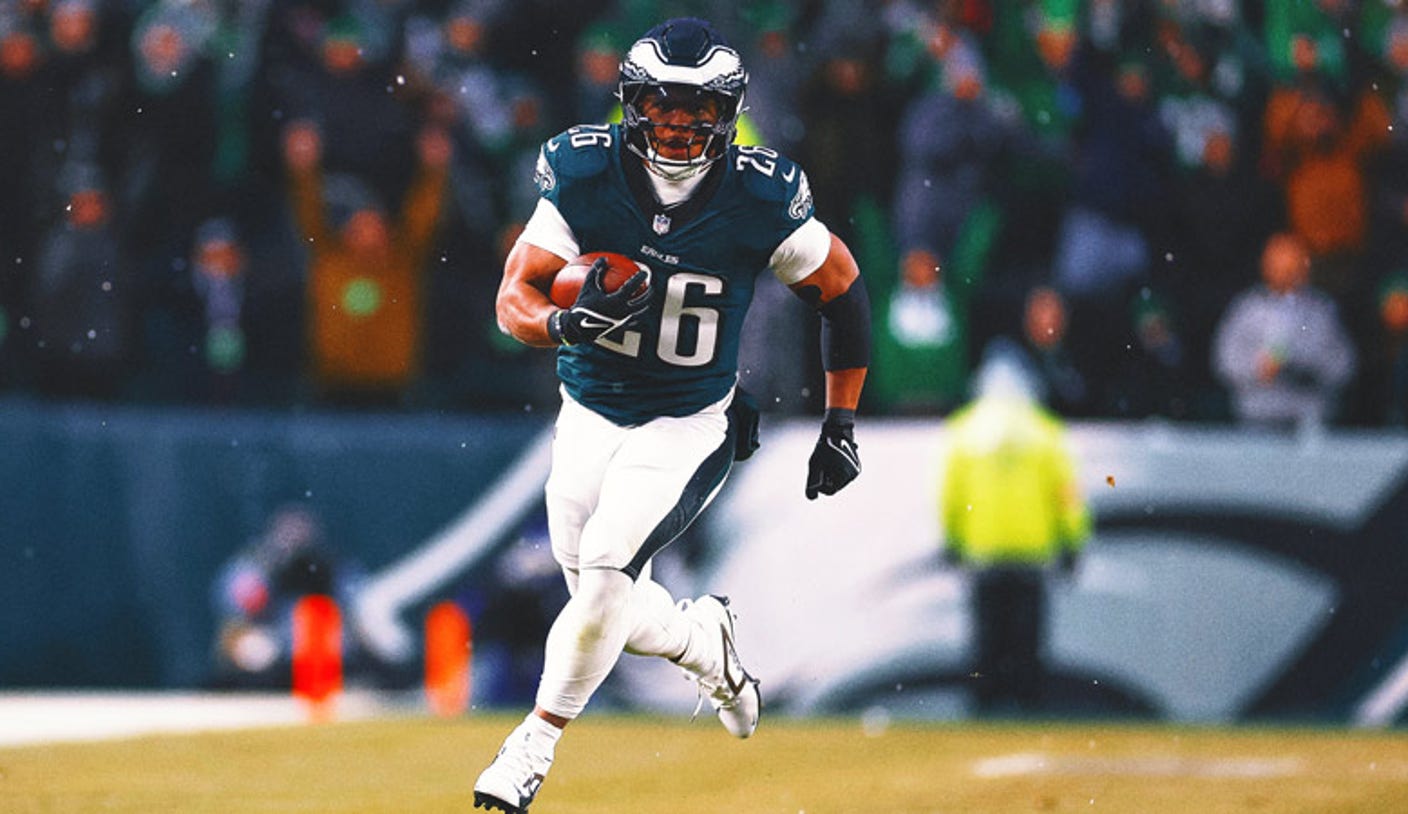
Saquon Barkley's 2024 season was one of the greatest by an NFL running back in the modern era. 2,005 rushing yards in the regular season. 2,504 rushing yards including playoffs, an NFL record that broke Terrell Davis's 1998 mark of 2,476. Seven 60+ yard rushing touchdowns in a single season, also an NFL record. Career-best 5.8 yards per carry. The 255-yard franchise single-game record. The Super Bowl LIX ring.
The 2025 season was a different story.
Barkley finished 2025 with 1,140 rushing yards, 7 touchdowns, and 4.1 yards per carry. The line was still good. The team made the playoffs (wild-card loss to the Rams). But the gap between 2,005 yards and 1,140 yards is the difference between a transcendent year and a normal good year. Saquon himself called it a step back at minicamp: "I don't feel like I performed at a high enough level."
The question for 2026 is whether the encore can return to historic production. The answer requires looking at three variables: workload, scheme, and health.
The Workload Math
The 2024 season was carried (literally) by volume. Barkley took 345 carries in the regular season, which led the NFL. He averaged 5.8 yards per carry on that volume, which is the unicorn combination: elite efficiency at elite volume. Most backs cannot sustain 5+ YPC over 350+ carries.
The 2025 season saw the workload drop to 280 carries for 1,140 yards (4.1 YPC). The volume dropped 19 percent. The efficiency dropped 29 percent. Both numbers regressed.
The 2026 question: does the volume return to 2024 levels, and if so, can the efficiency follow?
- Sean Mannion's offense is run-heavy. The Vikings under similar scheming ran the ball at the second-highest rate in the NFC last season. The Packers (Mannion's most recent system) were top-10 in rushing attempts.
- The Eagles WR room is in transition. With A.J. Brown gone and Makai Lemon's hamstring uncertain, the path of least resistance for the new offense is to lean on Saquon early and often.
- Carter on the defensive side is a hold-in / contract situation. If the Eagles are uncertain about the defensive ceiling, they may lean on ball control offensively to shorten games. That means Saquon.
A reasonable 2026 projection is 310-330 carries. The efficiency needs to climb back to the 5.0+ YPC range to hit 2,000 yards on that volume. The path:
The Scheme Fit
The 2024 offense under Kellen Moore was already a wide-zone-friendly scheme. The 2025 offense under Kevin Patullo became more inside-zone and gap-scheme. Saquon's individual production matches with wide zone better than gap-scheme runs (his style is one-cut and go, not stretch-and-bounce).
The Mannion offense being installed in 2026 returns the run game to the wide zone / outside zone system that LaFleur ran in Green Bay (top-five rushing efficiency multiple seasons). This is the scheme that produces:
- More runs from under center (which Lane Johnson publicly said is one of his favorite Mannion install changes)
- More pre-snap motion to manipulate defensive numbers in the box
- Play-action that creates softer second-level defenders for Saquon to attack at the linebacker level
- Tight end-heavy blocking schemes that play to Dallas Goedert's strengths
Goedert himself, at his June 9 press conference, said the tight end is "the backbone of the offense, both in the run game, play action, pass game." Translation: the scheme is built around the same blockers who used to clear the way for Saquon's franchise-record 255-yard game in 2024.
The Receiving Game Multiplier
Saquon's 2024 line included 33 receptions for 278 yards and 2 TDs. Modest by his Giants standards (he had 91 receptions in 2018 as a rookie).
The Mannion offense puts the running back into the receiving game more aggressively than the previous Eagles scheme did. In Green Bay, Josh Jacobs caught 36 passes in his first year in Mannion's QB room. In Minnesota under O'Connell, Aaron Jones caught 51 passes in 2024 at age 30.
A reasonable 2026 projection for Saquon as a receiver: 40-55 receptions for 350-450 yards. That is not a transformative number, but it adds 100-150 scrimmage yards over 2024. The combined scrimmage yard total goes from 2,283 (2024) to a projected 2,400-2,500 range. That is in the historical conversation for most all-purpose yards in a season.
The Health Question
Saquon turned 29 in February 2026. The historical aging curve for NFL running backs is brutal: backs at age 29-30 see meaningful efficiency declines, especially after seasons with 300+ carries.
The counter-argument:
- Saquon's 2025 season was actually a load-management year. He never had a season of less than 290 carries before 2024 (with the Giants); the 280 carries in 2025 was below his career baseline.
- He had a full offseason for the first time in years (not coming off a Super Bowl run, not rehabbing a major injury). He told media at the start of OTAs the lack of post-Super-Bowl turnaround was meaningful: "You get a little more time to work on yourself. I felt like I was able to get into better shape coming into the offseason."
- The Eagles drafted no high-upside RB in the 2026 NFL Draft. Will Shipley (Year 3) and Tank Bigsby (free agent acquisition) are the depth, but neither is a workload-stealer at Saquon's level. The lead-back share is his.
The realistic 2026 health scenario: Saquon plays 16 games (slight rest game in Week 18 if Eagles have clinched), takes 310-325 carries, stays at 5.0+ YPC because the scheme fits him better than 2025's did, and finishes the regular season at 1,700-1,900 yards. The 2,000-yard line is achievable but not guaranteed.
The 2,000-Yard Threshold
Eight running backs in NFL history have broken 2,000 rushing yards in a season:
- Eric Dickerson (1984)
- Barry Sanders (1997)
- Terrell Davis (1998)
- Jamal Lewis (2003)
- Chris Johnson (2009)
- Adrian Peterson (2012)
- Derrick Henry (2020)
- Saquon Barkley (2024)
Nobody has broken 2,000 yards twice in their career. Derrick Henry came closest, with a 2,027-yard season (2020) and a 1,538-yard season the next year (when he missed eight games). Adrian Peterson followed his 2,097-yard 2012 with a 1,266-yard 2013.
If Saquon hits 2,000 again in 2026, he would become the first player in NFL history to break 2,000 yards in two separate seasons. That is the magnitude of the chase.
What Would It Take?
Specifically:
- Carries: 310-330
- YPC: 5.0+ (a return to 2024 efficiency)
- Health: 16-17 games played
- Scheme: Mannion's wide zone delivers as expected
- Game scripts: The Eagles play with leads more than they did in 2025, opening up the run game in the second half of games
None of those are absurd. All five hitting simultaneously is the bet. The reasonable over/under for Saquon in 2026 is 1,650 yards. The 2,000-yard ceiling is on the table if the offense functions and the line stays healthy. The 2,500-yard NFL record is probably not realistic in any scenario but cannot be ruled out if every variable breaks the right way.
What This Means for the Eagles
The 2026 Eagles do not need 2,000 yards from Saquon to win the Super Bowl. They need 1,500+. They need Saquon to be available for January football. They need him to take pressure off the new offense while it learns its new playbook.
If they get the 2,000-yard encore, it is a bonus. If they get the 1,500-yard floor, the offense is still capable of winning at the level the defense will support.
What is realistic to expect: Saquon's 2026 season is closer to his 2024 than his 2025. The scheme fits better than 2025's did. The volume should return. The efficiency should climb. The 2,000-yard chase is back on the table by mid-November.
The franchise has the kind of running back who can be the centerpiece of a championship offense. That player is back in a system that wants him to be exactly that. Week 1 starts the encore.